Many drivers believe electric cars are a 21st-century marvel. In reality, they have been part of the global transport sector for over one hundred years.
The latest arrival in this evolving market is direct current, or fast, power delivery. This modern infrastructure promises to refuel your vehicle in minutes, not hours.
In this article, I explore the complex relationship between high-speed energy delivery and the long-term health of your car's power pack. Does the sheer convenience outweigh any potential risks from frequent high-power energy intake?
My analysis covers the technical nuances of how different power delivery methods impact internal chemistry over time. I provide essential information to help you understand if this is a genuine concern for your daily habits.
By reviewing manufacturer guidelines and recent research, I aim to clarify the best practises for maintaining your investment for many years ahead.
Key Takeaways
- Electric vehicles are not a new invention; they have a history spanning more than a century.
- The fastest power delivery methods, often called direct current charging, are a recent innovation.
- Frequent high-power energy intake may affect your car's long-term energy storage system.
- Manufacturer guidance is crucial for understanding the recommended care for your vehicle.
- Grasping the technical details helps you make informed decisions about your driving and refuelling habits.
- Finding a balance between convenience and battery preservation is often the wisest strategy.
- This analysis provides clarity to help you protect your financial investment in electric mobility.
Understanding EV Charging Modes
The landscape of electric vehicle refuelling is defined by three distinct power delivery methods, each with its own purpose and performance. Grasping these differences is your first step towards smarter energy management for your car.
Overview of Mode 2, Mode 3 and Mode 4
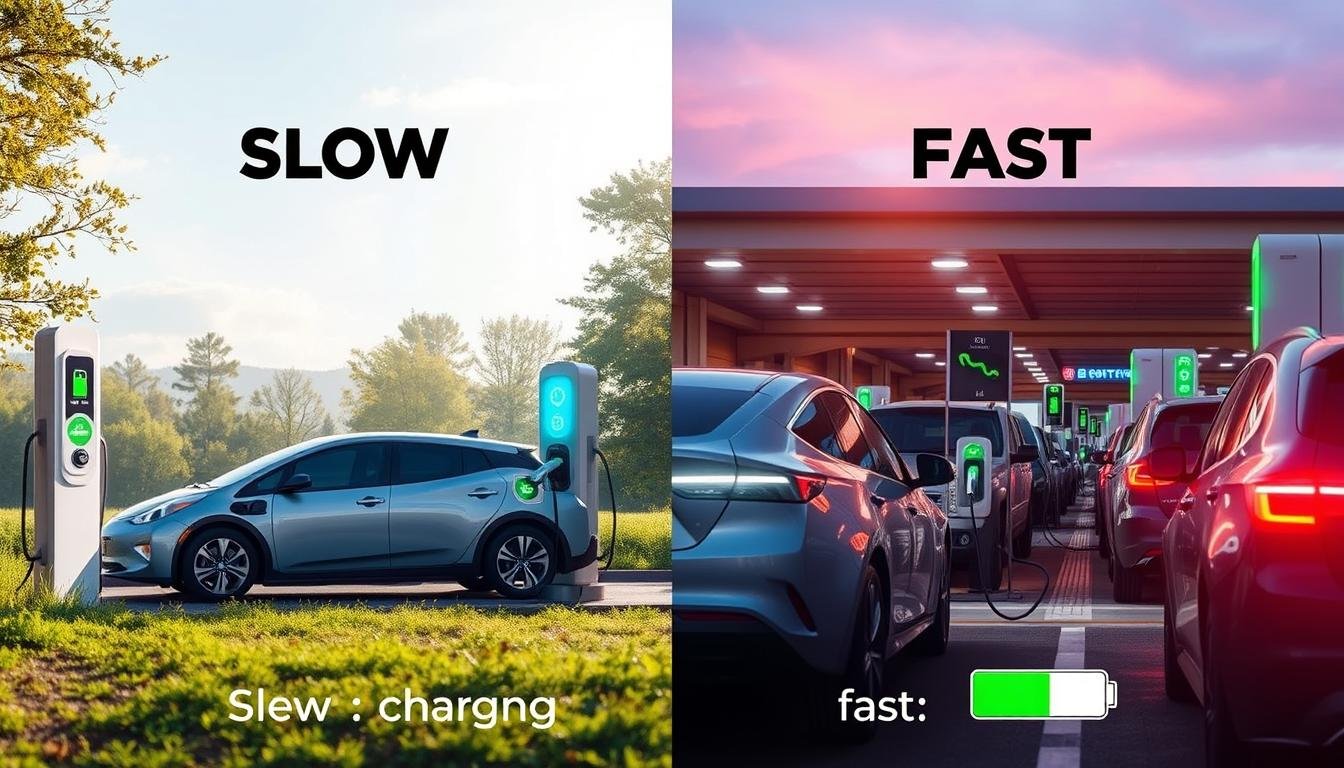
These three types serve different needs. The slowest, often used at home, provides a gentle energy transfer. You can expect to add roughly 6 to 8 kilometres of range per hour.
A faster alternative is commonly found in public car parks and workplaces. This type can deliver enough power for up to 120 kilometres of travel in a single hour, making it ideal for longer stops.
The fastest method bypasses your car's internal systems entirely. It feeds direct current straight into the power pack at very high rates.
- Home (Slowest): 1.3 kW to 2.4 kW output.
- Public (Faster): 3 kW to 22 kW output.
- Direct Current (Fastest): 50 kW to 350 kW output.
AC to DC Conversion and Its Impact
The core difference lies in where a critical conversion happens. Your domestic grid supplies alternating current (AC), but your vehicle's power pack stores direct current (DC).
With the first two methods, a converter inside your car handles this change. This onboard equipment has a limited capacity, which governs the speed.
The fastest stations perform this conversion externally. By delivering DC directly, they enable much higher power transfer. My analysis in this article notes that top-tier terminals can add hundreds of kilometres of range swiftly.
This external process is powerful, but it requires careful management to avoid excessive heat buildup in your vehicle's energy storage system.
Insights into mode 4 charging battery degradation
Frequent use of the fastest power delivery method raises questions about its impact on component health. I investigate how rapid energy intake affects internal cell structure and overall longevity.
How High-Power Rapid Delivery Affects the Power Pack
Consistent use of Level 3 DC fast energy delivery can increase wear. Studies show an average rise of 3-5% in capacity loss over 50,000 miles.
This happens because the power pack has a maximum load capacity. It can only accept a limited number of kilowatts during each session.
Research and Manufacturer Guidelines
Research indicates that while convenient, this method leads to measurable capacity loss over high mileage. Manufacturers set specific limits on power intake to prevent immediate damage.
My review suggests a balanced approach is needed for optimal health. Smaller energy stores, like those in the Fiat 500, are not suited for high-power delivery.
| Vehicle Model | Maximum Accepted Power (kW) | Suitable for High-Power Delivery? |
|---|---|---|
| Fiat 500 Electric | 50 kW | Limited |
| Nissan Leaf | 100 kW | Yes |
| Tesla Model 3 | 250 kW | Yes |
Impact of Fast Charging on Battery Temperature and Chemistry
Understanding the interplay between temperature and internal chemistry is key to preserving your car's range over many years. Rapid energy delivery stresses this system by generating significant warmth.
Effects of High Temperatures on Battery Life
High heat accelerates unwanted chemical reactions inside the cells. This process, known as degradation, permanently reduces storage capacity.
Your vehicle's range can drop by 5% at 32°C (90°F). In very warm climates, a loss of 31% is possible once temperatures exceed 38°C (100°F). The thermal management system works hardest during a fast charging session to counteract this.
Cycle and Calendar Ageing Considerations
Two main processes dictate your power pack's lifespan. Cycle ageing occurs from repeated use, while calendar ageing happens naturally over time.
Extreme temperatures significantly worsen both. The heat from rapid power intake pushes the chemistry beyond its ideal, safe window.
| Ageing Type | Primary Cause | Impact of High Heat |
|---|---|---|
| Cycle Ageing | Repeated charging & discharging | Greatly accelerated |
| Calendar Ageing | Passage of time | Moderately accelerated |
| Thermal Stress | External & internal temperatures | Direct cause of damage |
Controlling cell temperatures is arguably the single most important factor for long-term electric vehicle battery health.
My advice is simple: avoid topping up your energy store when it's extremely hot or cold. Let the car's systems stabilise the temperature first. This preserves the chemical integrity for the long haul.
Charging Equipment and Infrastructure Considerations
Selecting robust cables and reliable power points is fundamental for efficient and safe vehicle refuelling. The right gear ensures stable energy transfer and protects your investment.
Importance of High-Quality Cables and Connectors
Superior cables use materials like 100% silvered copper. This cuts electrical resistance and lowers heat during use.
Brands such as Voldt® design their products to meet strict international standards. These include IEC 62752 and IEC 61851.
Certifications from CE and TÜV confirm safety and durability. This is vital for long-term performance.
| Certification | Scope | Key Benefit |
|---|---|---|
| CE Mark | European Conformity | Ensures product safety for the EU market |
| TÜV | Technical Inspection | Independent verification of quality and safety |
| IEC 62752 | In-cable control box | Defines safety for portable refuelling devices |
| IEC 61851 | EV conductive power supply | Sets requirements for stationary refuelling systems |
Using certified equipment is not just a recommendation; it's a cornerstone of operational safety for electric vehicles.
Evaluating Charging Station Safety and Efficiency
A reliable station has an internal control box. This monitors current flow to prevent surges.
Always choose gear that aligns with your carmaker's guidelines. This supports the health of your energy system.
Look for durable, weather-resistant designs. They prevent faults from poor connections over time.
Charging Costs and Economic Considerations
Paying for the convenience of rapid power delivery often involves a premium price. The fastest refuelling method is generally more expensive than slower alternatives. This is due to the high-powered infrastructure required and the sheer speed offered.
Different networks use varied pricing models. Some charge per kilowatt-hour (kWh) of energy delivered. Others bill per minute connected, or use a hybrid of both systems.
Understanding your vehicle's maximum acceptance rate is key. If your car can only take 50 kW, using a 250 kW terminal may not speed up the session. You could end up paying more per minute for energy you cannot physically accept.
| Pricing Model | How It Works | Typical Cost Example |
|---|---|---|
| Per Kilowatt-Hour (kWh) | You pay for the total energy transferred into your car. | £0.50 - £0.85 per kWh |
| Per Minute | You pay for the time your vehicle is connected to the station. | £0.30 - £0.60 per minute |
| Hybrid (Combination) | A lower per-minute fee plus a per-kWh cost applies. | £0.20/min + £0.40/kWh |
For drivers on long journeys, balancing cost with the need for quick replenishment is vital. Planning stops around your car's capacity can save money. Choosing the right method ensures your vehicle is ready without unnecessary expense.
Optimising Charging Behaviour for Battery Longevity
Adopting intelligent refuelling habits can significantly extend the life of your electric car's power pack. Simple adjustments to your routine make a substantial difference over years of ownership.
Smart Charging Practices and Timing
I recommend maintaining your energy store between 20% and 80% capacity. This avoids the stress that comes from extremely full or empty states. Most modern vehicles allow you to set a maximum charge limit via their onboard system or app.
Schedule your sessions for off-peak hours. This is often cheaper and reduces strain on the grid. Your car's smart technology can handle this automatically.
Using regenerative braking during daily commutes also helps keep the state of charge within this optimal band.
Balancing AC and DC Charging Methods
For daily use, rely on the slower, alternating current method. It's gentler on the cells. Reserve the direct current option for longer journeys when you need a quick top-up.
This balanced approach minimises heat buildup and chemical wear. It helps preserve your vehicle's range and performance for the long term.
EV Battery Maintenance and Driving Habits
Beyond the charging cable, a driver's behaviour on the road is a critical factor in maintaining a healthy power pack. While your choice of mode charging matters, how you operate your car daily has an equal impact on long-term preservation.
Driving Techniques to Minimise Degradation
Smooth, predictable driving keeps your vehicle's systems calm. Avoiding rapid acceleration and harsh braking reduces heat generation in the power pack.
Use regenerative braking whenever possible. This clever system captures around 22% of the energy typically lost during deceleration. It feeds this power back to your energy store, supporting its health.
Long-Term Storage and Regular Check-Ups
If storing your vehicle for weeks, aim for a 40% to 60% state of charge. This middle ground minimises stress on the cells during inactivity.
Schedule regular professional inspections. A technician should check coolant levels in models with liquid thermal management. This prevents overheating issues before they start.
| Driving Style | Impact on Temperature | Regenerative Capture | Cumulative Wear |
|---|---|---|---|
| Aggressive | High & Peaky | Low | Significant |
| Moderate | Controlled | Good | Reduced |
| Conservative | Minimal | Optimal | Minimal |
Safety Standards and Certified EV Charging Equipment
Certified charging gear is not just an accessory; it's a critical component for protecting your vehicle and home from electrical hazards. Adhering to established safety protocols ensures every refuelling session is secure.
Overcurrent Protection Mechanisms
Overcurrent protection is a legal requirement under European standards. It ensures your charging equipment shuts off automatically during electrical faults.
Internal control boxes monitor current flow continuously. This keeps operations within safe, standardised limits to prevent damage.
Some advanced plug heads feature temperature sensors. These can pre-emptively reduce current if overheating is detected, adding a layer of safety.
Certifications, Regulations and Compliance
Always look for CE and TÜV marks on your equipment. These certifications confirm compliance with all necessary safety regulations.
For home installations, using a certified installer is crucial. Networks like Qmerit have deployed over 770,000 stations in North America, ensuring your setup is both safe and efficient.
This information helps you choose reliable charging stations that meet rigorous standards. It safeguards your investment for the long term.
Future Perspectives on Fast Charging and EV Longevity
The coming years will see a dramatic improvement in the convenience and efficiency of topping up an electric car. The future of fast charging looks bright as infrastructure expands. According to a Castrol study, 57% of OEMs state that 30-40 minute loading is already technically available. Yet, it remains inaccessible for most drivers.
To reach a tipping point for mass adoption, the average electric vehicle will need to offer more than 450 km of range with a 30-minute charge. My analysis suggests the next two years will be a turning point for large-scale EV adoption.
Technological Advancements in Charging Infrastructure
Manufacturers are working to improve cell chemistry to withstand future high-speed networks. This will help dispel common anxiety about refuelling availability. I provide information on these developments below.
The deployment of more rapid stations will make 30-minute charging a standard experience globally. Advances in charging modes will enhance accessibility for all vehicles.
I expect significant investments in public networks. This will reduce queueing time and increase reliability for all users.
| Advancement Area | Current Status | Projected Timeline | Impact on Driver Experience |
|---|---|---|---|
| Station Deployment | Limited availability in some regions | Widespread by 2026 | Reduced wait times, increased convenience |
| Vehicle Range | Average ~300 km | >450 km standard | Less frequent stops, longer journeys |
| Charge Speed | 30-40 minutes for 80% charge | Under 20 minutes target | Faster top-ups, akin to petrol station visits |
This table illustrates the key areas where progress is expected. The synergy between car and charger is crucial.
Conclusion
This analysis leads to a clear verdict: informed, balanced practices are your best defence against premature wear. I have outlined how heat management and thoughtful refuelling habits directly influence your electric car's long-term performance.
For daily use, prioritising slower AC power delivery preserves your energy store. Reserve rapid DC top-ups for longer journeys. Always choose certified equipment and schedule regular maintenance checks.
Following these steps protects your investment and maintains your vehicle's range. I hope this guidance empowers you to make confident choices for the long term.